Master Medical Spa Digital Marketing in 2026 with LeadCroc
21 minutes
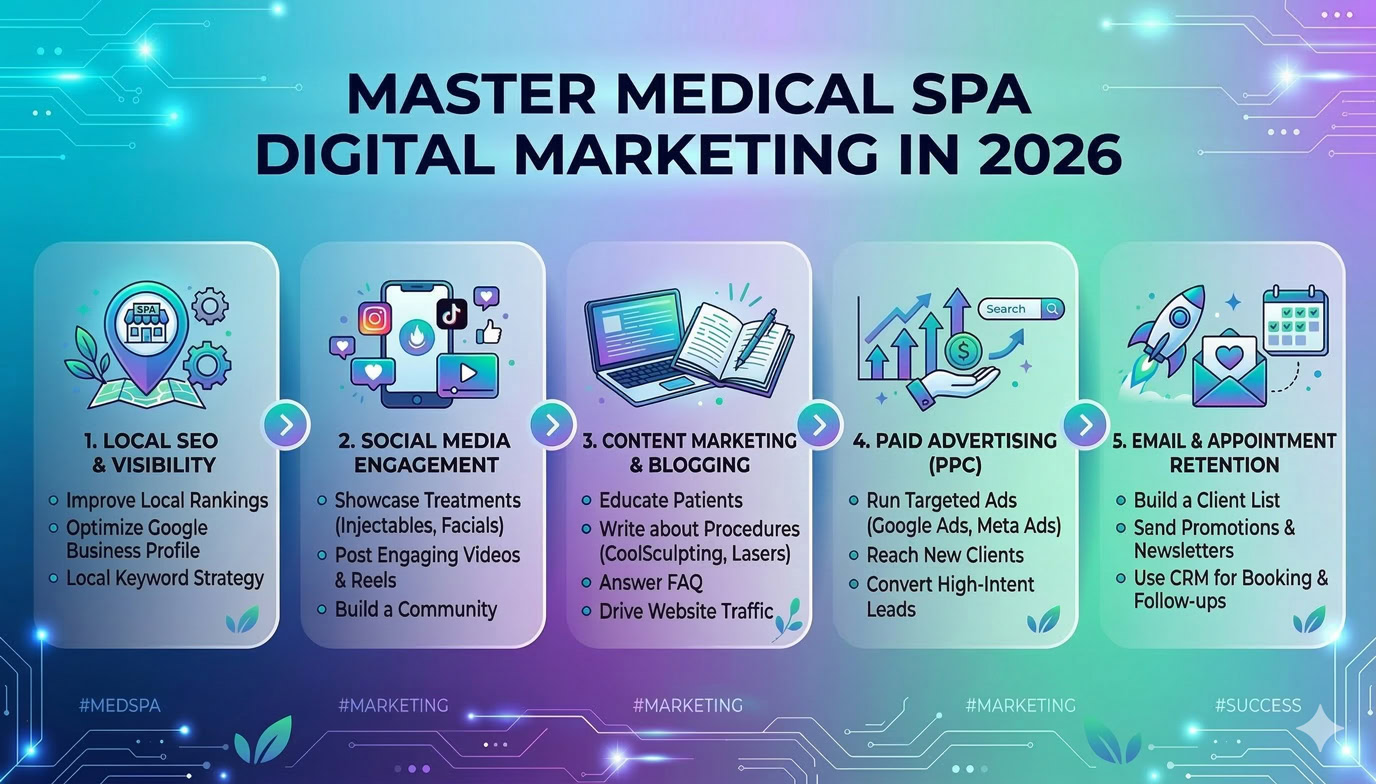
Medical spa digital marketing has become essential as the industry races toward $78.3 billion by 2033 and grows at a CAGR of 15.77%. So your digital storefront now matters more than your physical location.
Digital marketing refers to the use of electronic devices and online channels such as computers, mobile devices, websites, social media, and email to promote products and services and engage with customers. The benefits of digital marketing include precise audience targeting, measurable results, and significant opportunities for business growth compared to traditional marketing methods. Online platforms are the primary channels through which content is consumed and marketing efforts are executed, making them crucial for any successful digital marketing strategy.
Here’s what makes this critical: 80% of customers use Google Search to find local businesses, and companies that leverage online scheduling and analytics generate 27% more revenue than competitors. For medical spas, digital marketing is important because it provides accessible, cost-effective ways to communicate with your target audience and drive growth. Digital marketing is important due to its accessibility, cost-effectiveness, and the wide array of communication channels such as social media, email, and search engines that allow you to reach and engage your audience wherever they are online. Scaling your med spa to seven figures requires a move from passive marketing to a proactive, integrated growth blueprint.
This piece walks you through proven medical spa marketing strategies to establish your online presence and convert visitors into loyal customers. Let’s explore!
In today’s digital world, a robust digital marketing strategy is no longer optional for medical spas—it’s essential for business success. As the aesthetic industry becomes increasingly competitive, medical spas must harness the power of digital marketing channels to stand out, attract new clients, and build brand awareness. By leveraging social media marketing, search engine optimization, and content marketing, medical spas can connect with their target audience where they spend most of their time: online.
A well-crafted marketing strategy enables medical spas to showcase their expertise, highlight their unique services, and engage with potential clients in meaningful ways. Whether your goal is to increase bookings, educate your audience, or establish your spa as a trusted authority, digital marketing offers the tools and tactics needed to achieve your marketing goals. By embracing digital marketing essentials, medical spas can create a strong online presence that drives growth and positions them for long-term success.
Digital marketing refers to the promotion of products and services through digital channels such as search engines, social media platforms, and email marketing. In the rapidly evolving aesthetic industry, staying ahead of digital marketing trends is crucial for maintaining a competitive edge. An effective digital marketing strategy empowers medical spas to build brand awareness, drive targeted website traffic, and generate high-quality leads.
By utilizing a mix of digital marketing channels—including social media, search engines, and email—medical spas can reach a broader audience and foster customer loyalty. These digital channels allow for personalized communication, real-time engagement, and measurable results, all of which are vital for business success. As consumer behaviors shift and new technologies emerge, medical spas that prioritize digital marketing are better positioned to adapt, grow, and thrive in a dynamic marketplace.
Your website functions as the first evaluation point for potential clients researching esthetic treatments. Mobile optimization remains non-negotiable, as 71% of med spa bookings start on mobile devices. This highlights the importance of mobile marketing strategies that specifically target mobile users through SMS, social media, and apps, ensuring your business effectively reaches consumers where they spend most of their time. Pages must load within three seconds to prevent visitor abandonment. Responsive design ensures your site adapts naturally on smartphones, tablets and desktops. Technical SEO—including optimizing website architecture, improving mobile-friendliness, and enhancing site performance—is crucial for ensuring your website ranks well in search engine results and provides a seamless user experience. Optimizing each web page by focusing on on-page elements, technical SEO components, and the overall structure is essential to improve search engine rankings and increase your site’s visibility.
Clear calls-to-action placed above the fold are essential. Each page should guide visitors toward booking consultations or scheduling treatments. Immediate online booking systems that allow clients to check availability and select services will give a smooth experience. Clients receive instant confirmations. This reduces friction and can increase bookings by more than 30%.
Your Google Business Profile serves as your digital storefront before prospects visit your website. Claim your listing at business.google.com, then verify ownership through postcard, phone or email. Complete every section with accurate business name, address, phone number and operating hours.
“Medical Spa” should be your primary category. Add secondary categories like “Skin Care Clinic” or “Laser Hair Removal Service” based on your offerings. Maintain NAP consistency on all online directories including Yelp, Healthgrades, RealSelf and WebMD. Inconsistent information on platforms confuses search engines and can hurt your local rankings.
Dedicated landing pages for each treatment you offer are crucial. These pages target high-intent searches like “Botox [City]” or “laser facial near me”. Each page needs clear titles and compelling introductions that address client concerns. Detailed treatment overviews using bullet points improve readability.
FAQ sections in collapsible accordion format address common questions about sessions needed, pain levels and downtime. Pricing information or “Request Pricing” buttons remove booking barriers. Location-specific keywords throughout the content strengthen local search relevance.
High-quality images of your clinic, treatment rooms, equipment and team belong on your website and Google Business Profile. Photos can increase direction requests by 42%. Before-and-after galleries showcase real patient transformations with proper consent and become your highest-converting website element.
Video content drives 79% higher conversion rates. Video marketing is a powerful strategy to promote your medical spa using platforms like YouTube, TikTok, and Instagram, helping you reach and engage a wider audience. Treatment demonstration videos show procedure duration and patient comfort levels. Client testimonial videos featuring real stories build social proof. Educational tip videos answering common questions position your staff as experts and support your medical spa marketing strategies.
Medical spas have access to a wide range of digital marketing channels, each offering unique benefits for reaching and engaging their target audience. Paid digital marketing channels, such as Google Ads, provide immediate visibility and can quickly drive qualified traffic to your website. Organic channels, like search engine optimization (SEO), help improve your website’s ranking in search engine results, attracting clients who are actively searching for your services.
Social media marketing is another powerful tool, enabling medical spas to build brand awareness, share valuable content, and interact directly with potential clients on platforms they use daily. By combining these types of digital marketing paid, organic, and social medical spas can create a comprehensive marketing strategy that maximizes reach and impact. Understanding and leveraging the right mix of digital marketing channels is key to connecting with your target audience and achieving your business objectives in the digital age.
Proximity-based searches drive immediate action. Potential clients who search “Botox near me” or “med spa in [city]” demonstrate high booking intent. Studies confirm that 78% of local mobile searches for med spas guide to an appointment within 24 hours. Your Google Business Profile placement in the Local 3-Pack determines whether these searchers contact you or competitors directly.
Target decision-stage keywords that include your city, neighborhood and service terms. Upload fresh photos weekly. Post regular updates about treatments and promotions to signal active business status. Searches including “near me” have increased 500% over the last several years. This makes geographic optimization critical for your medical spa marketing plan.
Most prospects won’t book during their first visit. Retargeting displays follow-up ads to people who viewed your booking page, browsed treatment information or visited your site within the last 30 days. Install tracking pixels on your website to capture this audience data. Retargeting strategies often use digital ads and paid ads to re-engage visitors, leveraging targeted ad online placements across multiple platforms to maximize reach and conversions.
Facebook and Instagram give medical spa owners access to audiences who already care about beauty and wellness services. Most med spas generate meaningful results starting at $1,000 to $3,000 per month. Retargeting can boost conversion rates by a lot when you show ads featuring limited-time offers or client testimonials. Platforms like Google and Meta use pay per click models, where you pay only when users click your ad online. Search engine marketing is another effective strategy, involving paid search ads like Google Ads, where digital ads are auctioned and targeted based on user searches to reach a broad, diverse demographic.
LeadCroc’s platform monitors prospect behavior including page clicks, stay duration and treatment interests. Business leaders leverage digital marketing automation tools like LeadCroc to enhance efficiency, allowing them to focus on strategic, high-touch tasks rather than repetitive activities. Integrating automation into your digital marketing efforts helps align strategies with business objectives and drives better results. Digital marketing automation is increasingly being adopted, with 88% of marketing organizations using it to improve efficiency. Marketing automation streamlines marketing tasks by automating them, saving time and reducing manual effort. Artificial intelligence (AI) is also becoming a key component in digital marketing, helping to analyze data and forecast results for greater digital marketing success. The system tags leads as hot, warm or cold based on engagement patterns. You can send personalized offers matching their specific interests. Direct integration with Meta and Google ad accounts tracks real conversion events like booked appointments.
Virtual events establish your medical spa as the local authority while providing value to potential clients. Topics covering skincare breakthroughs or anti-aging techniques attract quality attendees. Properly planned in-person events generate six figures. Dedicate 45 days to planning and 30 days to marketing to achieve strong attendance.
Visual proof converts skeptical browsers into booked appointments. Research shows 83% of consumers researching cosmetic surgery won’t think about a practice without before and after photos. Pair transformation images with video testimonials to create powerful social proof that showcases real results.
Mark The Spa Man helps medical spa owners share authentic client stories across digital platforms. His proven medical spa marketing strategies focus on Google Business Profile optimization, strategic paid advertising, and creating attention-grabbing campaigns. Advanced med spa advertising techniques include leveraging digital advertising and online advertising to reach target audiences and build brand awareness through channels like social media and pay-per-click. Online marketing refers specifically to marketing strategies executed via the internet, such as email, social media, and SEO, and is considered a subset of digital marketing. Email marketing campaigns are an essential component of digital marketing strategies, providing effective direct communication with customers and requiring best practices for campaign creation to maximize results. Native advertising is also used as a tactic, creating ads that mimic the look and feel of a platform, blending seamlessly with organic content on platforms like social media to improve engagement while maintaining transparency. Partner with specialists to access advanced med spa advertising techniques that turn leads into lasting customers.
Attracting prospects means nothing if they don’t book and return. You need strategic systems that remove friction and reward commitment to convert website visitors into loyal clients.
Online booking systems increase appointments by 20%. Make scheduling available 24/7 through mobile-friendly platforms. 70% of bookings happen on mobile devices. SMS and email reminders cut no-show rates substantially while keeping your calendar optimized.
Structure membership levels as Bronze, Silver, Gold and Platinum tiers with escalating benefits. Tiered programs generate 2.9 times more visits and 35% higher spending compared to non-members. Priority booking and exclusive treatment access motivate clients to advance through tiers.
Automated systems recover 15-25% of dormant clients without staff involvement. Individual-specific SMS and email outreach that identifies patients overdue for care generates 20-30% higher return rates compared to manual outreach. Each reactivated appointment worth $200 translates to $5,000 monthly in recovered revenue.
Review requests work best 6-12 hours after appointments when positive experiences remain fresh. Research confirms 76% of patients asked to leave reviews will comply. In fact, 93% of customers read online reviews before booking services.
Birthday campaigns targeting 150 active clients generate $660 in additional monthly revenue. Birthday emails with individual-specific treatment discounts or complimentary add-ons strengthen client relationships year after year.
In today’s digital world, the role of digital marketers has become indispensable for medical spas aiming to achieve business success. Digital marketers are responsible for crafting and executing an effective digital marketing strategy that leverages a variety of digital marketing channels including social media marketing, search engine optimization (SEO), and email marketing to connect with potential customers and build brand awareness. Marketing managers play a strategic role in overseeing these digital marketing campaigns and managing teams to ensure cohesive execution and alignment with business objectives.
Unlike traditional marketing, which relies heavily on static, one-way communication through channels like print ads, billboards, and television, digital marketing offers dynamic, two-way engagement. Traditional media, such as TV, radio, and print, are broad-reaching channels that traditional marketers use to reach large, generic audiences through established, offline methods. This allows businesses to interact directly with their target audience on social media platforms, respond to feedback in real time, and tailor marketing messages to individual preferences. Digital marketing is defined as any marketing action that occurs on digital platforms, regardless of whether the device is connected to the internet.
The result is a more personalized and impactful relationship with clients, which is essential for building customer loyalty in a competitive market.
One of the most significant limitations of traditional marketing channels is the difficulty in measuring campaign effectiveness. Traditional marketing often lacks the ability to track key performance indicators (KPIs) such as website traffic, conversion rates, and social media engagement. In contrast, digital marketing campaigns provide access to robust analytics tools that allow digital marketers to monitor and optimize their marketing efforts in real time. Analytics allow marketers to learn what is successful with consumers and adapt their marketing messages moving forward, and having good, accurate analytics and the know-how to interpret them can help marketers quickly cut campaigns that aren’t working and build better campaigns around concepts that have a proven track record of success. This data-driven approach enables continuous improvement, ensuring that marketing campaigns are always aligned with business goals and delivering measurable results.
Cost is another area where digital marketing offers a clear advantage. Traditional marketing channels like TV, radio, and print media typically have higher costs than digital channels. Traditional marketing methods can be expensive and often have a limited reach, making it challenging for small and midsize businesses to compete. Digital marketing channels, such as Google Ads, social media, and content marketing, provide a cost-effective way to reach a broader audience and target specific demographics. By utilizing these digital channels, medical spas can increase brand awareness, drive qualified website traffic, and generate high-quality leads without the hefty price tag of traditional advertising.
Digital marketers also harness the power of marketing automation, social media management platforms, and search engine optimization tools to streamline their marketing efforts and deliver personalized experiences at scale. Internet marketing is a subset of digital marketing focused specifically on marketing practices that rely on the internet, such as email, social media, SEO, and PPC.
The flexibility of digital marketing is another key benefit. Digital marketing allows organizations to establish a brand identity and has revolutionized the marketing industry. As digital marketing trends evolve and consumer behaviors shift, digital marketers can quickly adapt their strategies to stay ahead of the curve. The rise of influencer marketing and content marketing strategy, for example, allows medical spas to collaborate with social media influencers and create authentic, engaging content that resonates with their target customers.
Ultimately, digital marketing offers businesses the agility, measurability, and reach that traditional marketing simply cannot match. By embracing an effective digital strategy and staying up-to-date with the latest digital marketing essentials, medical spas can power digital marketing campaigns that drive growth, increase brand awareness, and achieve long-term business success. As the digital landscape continues to evolve, investing in skilled digital marketers and innovative digital marketing offers will be crucial for staying competitive and meeting the ever-changing needs of your target audience.
In the fast-paced digital world, staying ahead of the curve is essential for medical spas that want to achieve digital marketing success. The landscape of digital marketing is constantly evolving, with new digital marketing channels, tools, and strategies emerging every year. To remain competitive and maximize your marketing efforts, it’s crucial to keep your digital marketing strategy fresh and aligned with the latest digital marketing trends.
Digital marketers must regularly update their knowledge of social media marketing, search engine optimization (SEO), and search engine marketing (SEM) to ensure their marketing campaigns reach the right target audience. This means not only understanding how to optimize your website for search engines but also knowing which social media platforms and digital channels are most effective for engaging potential customers. Leveraging content marketing, influencer marketing, and native advertising can help build brand awareness and foster customer loyalty in ways that traditional marketing simply can’t match.
As mobile devices become the primary way people access the internet, mobile marketing has become a cornerstone of any effective digital marketing strategy. Ensuring your marketing materials and campaigns are optimized for mobile users is no longer optional it’s a digital marketing essential. Additionally, the rise of video marketing, pay per click advertising, and marketing automation tools has transformed how businesses connect with their audience and measure the impact of their marketing efforts.
To power digital marketing campaigns that deliver results, it’s important to create high-quality, engaging content tailored to your audience’s needs and preferences. This includes everything from compelling social media posts and transactional and promotional emails to informative blog articles and eye-catching digital ads. Monitoring key performance indicators (KPIs) such as website traffic, conversion rates, and social media engagement allows you to refine your digital strategy and ensure your marketing goals are being met.
Investing in digital marketing certification can also give your team a competitive edge. Certification programs provide up-to-date training on the latest types of digital marketing, from search engine optimization SEO to online advertising and marketing automation. This ongoing education empowers your team to implement innovative marketing methods, analyze search engine results, and adapt quickly to changes in the digital landscape.
Ultimately, staying up-to-date with digital marketing trends is not just about adopting new technologies—it’s about building a culture of continuous improvement and agility. By embracing the latest digital marketing offers, keeping an eye on emerging trends, and aligning your digital strategy with your business objectives, your medical spa can increase brand awareness, attract more potential customers, and achieve lasting business success in the digital age.
Data turns guesswork into strategic growth. The right metrics show you what generates revenue and what wastes money. Digital marketing efforts should be continuously aligned with business objectives and adjusted based on performance data. Digital marketing strategies can be customized and easily changed based on performance data to maximize results.
Rebooking rates matter more than new patient acquisition. Achieving 80% rebooking fills your schedule faster than bringing in 25 new patients monthly with only 30% rebooking. This metric creates immediate awareness among providers and front desk staff. You’ll see a 10-20% increase in rebooking just by measuring it.
Your original rebooking rate can be calculated using this formula: 100 × (total number of new clients who rebook after their first appointment ÷ total number of new clients). Monitor ongoing rebooking rates across all appointments to identify retention patterns as well.
Client lifetime value reveals what each patient contributes over their entire relationship with your spa. The calculation: CLV = (Average Revenue Per Customer × Customer Lifespan) − Total Costs to Serve. To cite an instance, if a client spends $500 per visit, visits 4 times yearly, and stays 3 years, their CLV equals $6,000.
New med spas should allocate 15-20% of revenue to acquire patients rapidly. Mature spas maintain growth at 8-12%. Track cost per acquisition and ROI across channels monthly. Channel performance comparison reveals which platforms deliver the highest conversion rates and lowest acquisition costs.
Review marketing performance quarterly. If Google Ads generate patients at $125 with a $6,200 lifetime value, that’s a 4,860% return. Reallocate funds from underperforming channels to those that achieve measurable results.
You now have the complete medical spa digital marketing blueprint to dominate your local market. Establish your online foundation first and then attract high-intent clients through targeted channels. Convert visitors into repeat customers with simplified booking and loyalty programs. Track your metrics consistently and double down on what gets results. This matters most. Execute with consistency and you’ll see your booking calendar fill up with qualified clients ready to invest in your services.
Master these essential strategies to transform your medical spa into a client-attracting powerhouse in 2026’s competitive landscape.
• Optimize for mobile-first experiences – 71% of med spa bookings start on mobile devices, making responsive design and 3-second load times critical for conversion success.
• Dominate local “near me” searches – 78% of local mobile searches lead to appointments within 24 hours, making Google Business Profile optimization your highest-ROI marketing activity.
• Focus on rebooking over new acquisition – Achieving 80% rebooking rates fills schedules faster than acquiring 25 new patients monthly with only 30% retention.
• Leverage visual proof and automation – Before/after galleries drive 83% of cosmetic treatment decisions, while automated booking systems increase appointments by 20%.
• Track client lifetime value religiously – Calculate CLV to identify your most profitable marketing channels and reallocate budget from underperforming campaigns to high-converting platforms.
The medical spa industry’s explosive growth to $78.3 billion by 2033 creates massive opportunities for practices that implement data-driven digital marketing strategies. Success requires shifting from passive marketing to proactive, integrated systems that attract, convert, and retain high-value clients consistently.
Digital marketing has become essential because 80% of customers use Google Search to find local businesses, and the medical spa industry is projected to reach $78.3 billion by 2033. Companies that leverage online scheduling and analytics generate 27% more revenue than their competitors, making a strong digital presence critical for growth and profitability.
Focus on optimizing your Google Business Profile by claiming your listing, maintaining consistent business information across all directories, and uploading fresh photos weekly. Target location-specific keywords like “Botox [City]” or “med spa near me” since 78% of local mobile searches lead to appointments within 24 hours. Create dedicated landing pages for each treatment you offer with location-specific content.
Implement a mobile-friendly online booking system that allows 24/7 scheduling, as this can increase appointments by 20%. Ensure your website loads within three seconds, place clear calls-to-action above the fold, and showcase before/after galleries since 83% of consumers researching cosmetic procedures won’t consider a practice without transformation photos. Use automated reminders to reduce no-shows.
New medical spas should allocate 15-20% of revenue for rapid patient acquisition, while established spas can maintain growth at 8-12%. For paid advertising on platforms like Facebook and Instagram, most med spas see meaningful results starting at $1,000 to $3,000 per month. Track your cost per acquisition and ROI across channels to optimize spending.
Monitor your rebooking rate (aim for 80% or higher), calculate client lifetime value using the formula: (Average Revenue Per Customer × Customer Lifespan) − Total Costs to Serve, and track cost per acquisition across all marketing channels. Review performance quarterly and reallocate budget from underperforming channels to those delivering the highest conversion rates and ROI.